The economy expanded by an estimated 4.5% in 2013, the fastest rate since the financial crisis. Oil and gas remain central to the success of the economy – the price of oil remains well above US$100 per barrel and the UAE is thought to have the seventh largest reserves in the world (98bn barrels) – accounting for close to 50% of total exports.
Dynamic businesses at the forefront of M&A activity highlights an increasing importance for M&A in driving growth. There is a clear acknowledgment from the 12,500 businesses surveyed that acquisitions will be needed to supplement existing operations.
24%: that is the proportion of women holding the most senior roles in businesses across the globe.
The role of leaders in creating successful businesses and driving growth is crucial. How these leaders run their teams and make decisions can be the difference between success and failure. But do the leadership characteristics displayed by leaders vary from region to region?
The lure of China’s less well-known cities and the opportunities they present has been picking up speed for years, along with their impressive growth. In fact, while they are often described as ‘second-tier’ cities, many are in fact now wealthier than their ‘first-tier’ counterparts.
The economy of France continues to suffer as the eurozone crisis continues. Following a deep contraction in 2009, the economy recovered robustly, posting seven consecutive quarters of expansion. However, France has stagnated over the past two years as problems in southern Europe intensified, with growth slowing as unemployment and government debt rise.
Sweden is an open, trade-oriented economy with a strong emphasis on supporting enterprise. It is therefore perhaps unsurprising, if still pleasing, to find the economy ranked third for the dynamism of our business operating environment in the Grant Thornton Global Dynamism Index (GDI) 2013. We are behind only Ireland and Canada on this measure in the 60-economy study.
I was interviewed this week by CNBC and BBC World News to discuss the economic outlook for 2014, drawing on the views of 3,500 senior executives in 45 economies we interview for our International Business Report (IBR).
The Philippine economy is growing fast. GDP expanded by 6.8% in 2012 and, whilst remittances climbed to a record high of US$23.8 billion in 2012, their share of GDP actually dropped to 8.5%, down from 9% in 2011.
Business optimism in markets such as China, the UK and the US has risen markedly over recent months according to the Grant Thornton International Business Report (IBR)[1]. And the most interesting aspect for me is the contribution of the real estate and construction sector to the brightening economic outlook.
I was interviewed last week by CNBC and BBC World News[1] to discuss our Q3 International Business Report (IBR) results. The big surprise was that business optimism in the UK more than doubled over the past quarter.
The Chinese economy is slowing. The days of rampant, double-digit expansion are in the past as we move away from massive investment and export dependency towards a more sustainable, consumption-driven model of growth. This rebalancing offers both challenges and opportunities for dynamic organisations. How these businesses adapt to the changing environment will be key to their growth prospects.
There was some great news for Chile in the latest edition of the Grant Thornton Global Dynamism Index (GDI): we ranked second out of 60 economies, behind only Australia.
According to our Global Dynamism Index (GDI) 2013, Australia is the economy businesses should be looking at. It climbed to the top of the ranking of 60 of the largest economies in the world this year, up from seventh place in 2012.
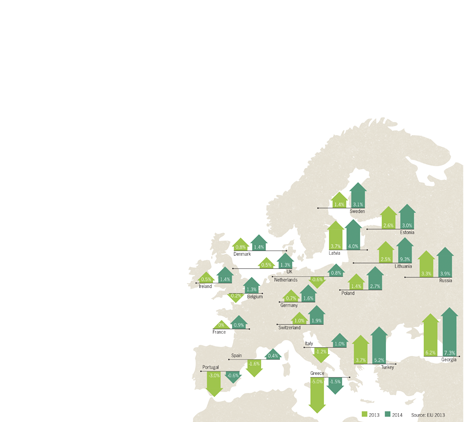
In the second of our Future of Europe series, we look at three aspects of the sovereign debt crisis: the stagnation of the region’s economies, closer integration and the future expansion of Europe.
Presidential elections in some of the world’s largest economies, the sovereign debt crisis and the US fiscal cliff have all contributed to a global sense of economic uncertainty. How are major and developing markets faring in the face of these developments and what does the year ahead have in store?