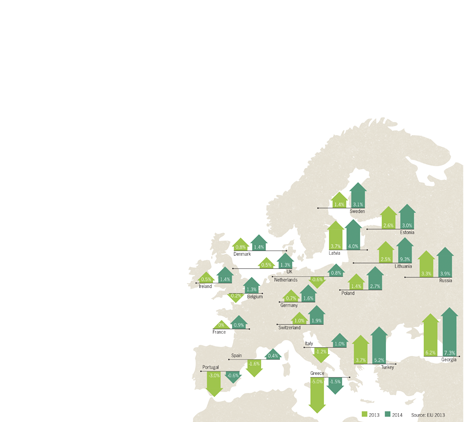
More and more fiscal authorities continue to develop their transfer pricing laws. The principles are common, although interpretations differ from one tax authority to another.

The economy of France continues to suffer as the eurozone crisis continues. Following a deep contraction in 2009, the economy recovered robustly, posting seven consecutive quarters of expansion. However, France has stagnated over the past two years as problems in southern Europe intensified, with growth slowing as unemployment and government debt rise.
Five years after the global financial crisis struck, residual effects continue to impact public financial management (PFM) in countries throughout the world.
IAS 39 ‘Financial Instruments: Recognition and Measurement’, the previous Standard that dealt with hedge accounting, was heavily criticised for containing complex rules which either made it impossible for entities to use hedge accounting or, in some cases, simply put them off doing so.
Global tax newsletter is designed to keep you up to date with significant tax developments around the world that impact businesses with cross-border operations. It addresses issues of a global nature as well as domestic tax developments of interest to foreign investors. The newsletter aims to cover tax developments on a regional and international basis.
This guide includes practical guidance on the detection of intangible assets in a business combination and also discusses the most common methods used in practice to estimate their fair value. It provides examples of intangible assets commonly found in business combinations and explains how they might be valued.
Welcome to the fourth edition of Transfer Pricing News. This provides updates on transfer pricing developments from a number of countries across the globe – a necessity in the global economy we all now inhabit.
In the second of our Future of Europe series, we look at three aspects of the sovereign debt crisis: the stagnation of the region’s economies, closer integration and the future expansion of Europe.
The appetite for cross-border deals has rocketed by 18% during the past 12 months. This is the key finding from our latest research that looks at attitudes to mergers and acquisitions (M&A) among business leaders worldwide.
The economy of France continues to suffer as the eurozone crisis continues. Following a deep contraction in 2009, the economy recovered robustly, posting seven consecutive quarters of expansion. However, France has stagnated over the past two years as problems in southern Europe intensified, with growth slowing as unemployment and government debt rise.
Presidential elections in some of the world’s largest economies, the sovereign debt crisis and the US fiscal cliff have all contributed to a global sense of economic uncertainty. How are major and developing markets faring in the face of these developments and what does the year ahead have in store?
Advanced Pricing Agreements (APAs) are helping to alleviate the risk of double taxation. In turn, Mutual Agreement Procedures (MAPs) may offer a smoother path to conflict resolution. But neither is a panacea.
Welcome to the third edition of Transfer Pricing News. This provides updates on transfer pricing developments from a number of countries across the globe – a necessity in the global economy we all now inhabit.
Classification of a financial instrument as either liability or as equity has an immediate and significant effect on an entity’s reported results and financial position. Liability classification for instance affects an entity’s gearing ratios and typically results in any payments being treated as interest and charged to earnings. This guide addresses the key application issues to consider and includes interpretational guidance in certain problematic areas.
This Expatriate tax ebook has been designed to provide an overview of the different tax systems around the globe and gives further information about tax systems and regulations in specific countries.
Through our International Business Report we’ve been keeping track of global figures on the appetites for both domestic and cross-border transactions since 2008.